As a 4th-year Bachelor of Science in Information Technology (BSIT) student at Bataan Peninsula State University, I have spent the last three years absorbing theory. We learn the "what" and the "how" of technology in the classroom. But as graduation approaches, a different question starts to loom over every student: "Can I actually do this in the real world?"
There is often a misconception that your "career" starts the day you receive your diploma. I disagree. I believe your career starts the moment you decide to take ownership of your skills. As I sat down to code this portfolio website, I realised that waiting until graduation to build a professional identity is too late.
In the competitive fields of UI/UX Design and Web Development, a degree proves you have the discipline to learn, but a portfolio proves you have the capability to execute. This article is a deep dive into my journey of turning academic assignments into professional assets, and why I prioritised building "real" experiences before leaving school.
When I first started drafting my CV, I felt intimidated. I looked at job descriptions asking for "3+ years of experience" and thought, "I'm just a student. I don't have 'real' clients yet."
The Shift in Mindset:
I realised that "experience" isn't limited to paid, 9-to-5 corporate work. Experience is found in:
Highlighting these achievements isn't bragging — it's documenting my growth.
1. The Logic Behind the Design: A Look at SmartFit
Many junior designers make the mistake of focusing only on "pretty screens." They fill their portfolios with Dribbble-style shots that look great but don't work. When I approached my project, SmartFit AR Footwear Retail Portal, I knew I had to go deeper.
SmartFit wasn't just about an Augmented Reality interface; it was a complex e-commerce system. To prove I understood the architecture, I focused heavily on System Documentation.
Why I Included UML and DFDs
In my portfolio, I explicitly showcased the Unified Modeling Language (UML) diagrams, Data Flow Diagrams (DFDs), and Entity Relationship Diagrams (ERDs). Why? Because in the real world, a designer who doesn't understand the data structure creates nightmares for developers.
"Design without logic is just art. Design with logic is a product."
By documenting the system flow — how a user account connects to a shoe customization, which then connects to the checkout database — I demonstrated that I can think like an engineer while designing like an artist. This bridges the gap between the IT department and the Design team.
2. Bridging the Gap: The "Generalist" Developer
There is an ongoing debate: Should designers learn to code?
My experience building Diwata Yoga gave me a definitive answer: Yes.
For the Diwata Yoga platform, I served as both the UI/UX Designer and Assistant Developer. This dual role forced me to face the consequences of my own design decisions.
This experience made me a better designer. Now, when I hand off designs to developers, I know exactly how the 'div' structure should look, and I understand the space between Grid and Flexbox layouts. This technical empathy is something I highlight proudly in my portfolio.
3. Soft Skills are Hard Skills: The Virtual Assistant Edge
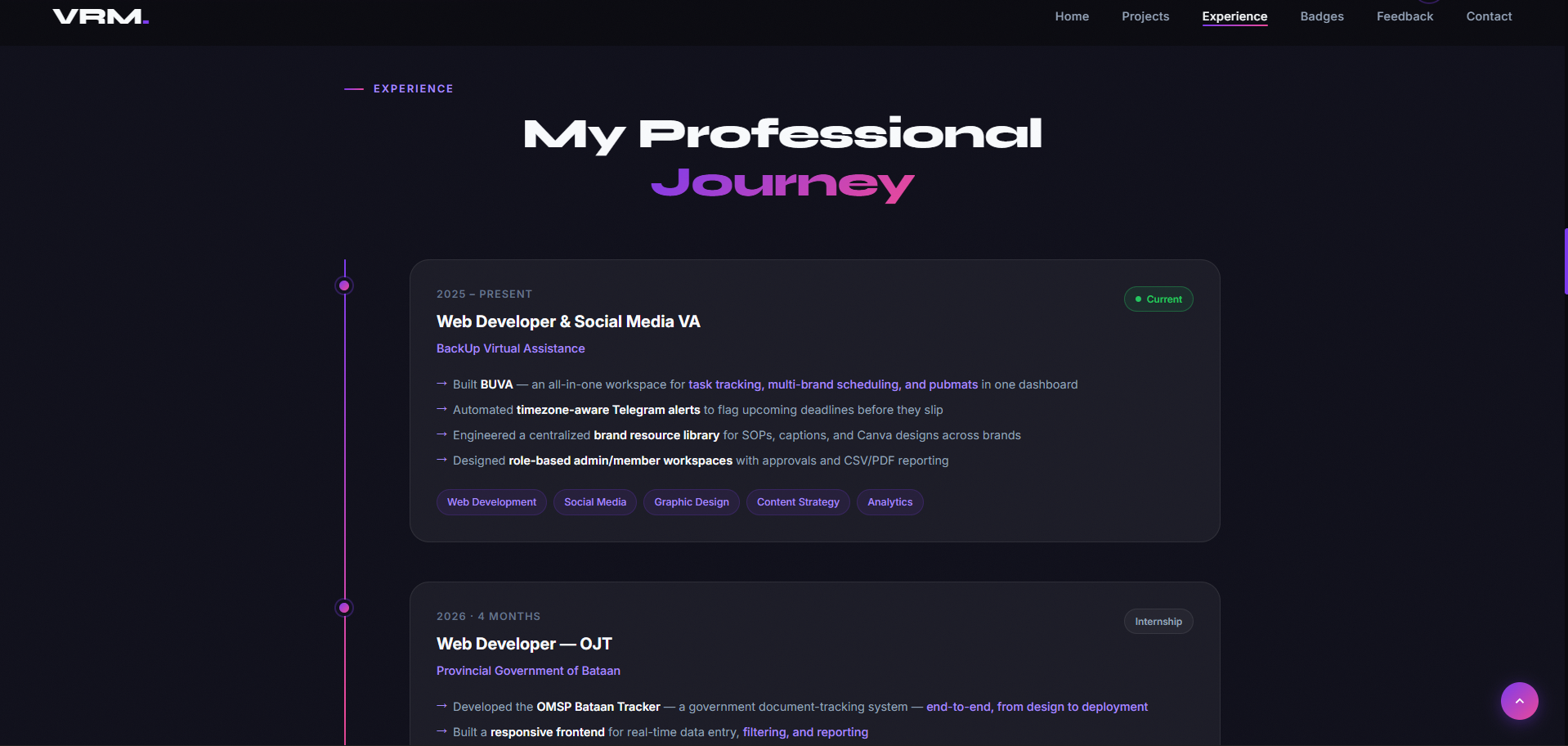
Technical skills get you the interview, but soft skills get you the job. My time working as a Social Media Virtual Assistant for Backup Virtual Assistant and as a Social Media Manager for Tayca's Travel provided me with invaluable "user research" experience.
How Virtual Assistance Improved My UX:
- Customer Empathy: Handling direct inquiries and complaints taught me exactly where users get frustrated. I bring this patience and understanding into my User Personas.
- Communication: Explaining digital concepts to non-tech clients honed my ability to simplify complex information — a core skill in UX Writing.
- Adaptability: Managing content calendars and sudden operational changes taught me to stay agile, a mindset essential for modern Agile development cycles.
While projects show what I can build, certifications prove what I know. I made a strategic decision to earn badges from my university, including:
These aren't just badges; they are proof of a continuous learning mindset.
4. Why You Should Start Now
If you are a student reading this, or a recruiter looking at my path, here is my takeaway: Don't wait for permission to be a professional.
Building this portfolio was more than a coding exercise; it was a strategic career move. It allowed me to:
-
Audit my own skills: I identified gaps in my knowledge and filled them (e.g., learning more advanced JS for the Opportunity job portal).
-
Control the narrative: Instead of being "just a fresh grad," I am a "Junior Designer with documented project experience."
-
Show, Don't Tell: I don't just say I'm detail-oriented; my pixel-perfect code proves it.
Conclusion
The journey from the classroom to the boardroom is not a straight line. It is built project by project, bug by bug, and client by client. By highlighting my work on SmartFit, Diwata Yoga, and my background in Virtual Assistance, I am positioning myself as a professional who is ready to add value from day one.
To my fellow students: Start building. Start documenting. Your future self will thank you.